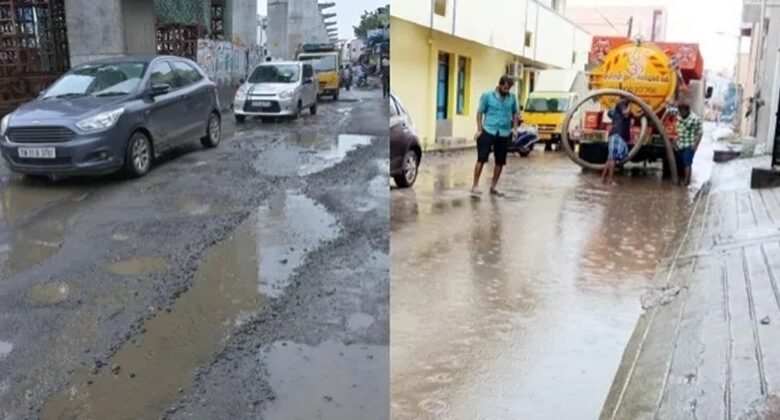
The Southwest Monsoon has once again exposed the vulnerability of Chennai’s civic infrastructure. Despite repeated assurances from the Tamil Nadu government that the city was “rain-ready,” several areas remain waterlogged, with damaged roads, stalled traffic, and frustrated residents questioning how a reported ₹4,000 crore spent on stormwater drain works could yield such poor results.
Meanwhile, Chief Minister M.K. Stalin had recently claimed that 97% of the drainage work was complete and that Chennai was fully prepared to face the rains. However, continuous showers over the past few days have brought the city to a standstill, reviving debates over mismanagement and poor planning.


Several arterial stretches, including Anna Salai, Arcot Road, Sardar Patel Road, and Old Mahabalipuram Road (OMR), have developed deep potholes and craters, disrupting vehicular movement. Residents and motorists reported that a usual 30-minute commute from Guindy to Greams Road now takes nearly two hours.
“These are not potholes but craters,” said one commuter, adding that the flooding and uneven roads have become life-threatening for two-wheeler riders. Even newly developed roads under the Smart City Mission have failed to withstand rainfall, raising concerns about the quality of the work executed.
In a rare and embarrassing development, traffic police officers were seen filling potholes with gravel to ensure smoother traffic flow. Videos circulating on social media showed policemen using sand and stones to patch up damaged stretches, drawing public criticism.
“Why should traffic police be repairing roads?” asked several residents online, accusing the Greater Chennai Corporation of administrative failure. The rain-related issues have also led to tragic consequences. Last month, a two-year-old child died after falling into a waterlogged pit in north Chennai.
Environmentalists have expressed concern over toxic chemical foam seen along the Marina Beach shoreline, believed to have resulted from sewage and industrial waste mixing with rainwater. Opposition parties, including the AIADMK and BJP, have strongly criticised the DMK government for its handling of the city’s civic infrastructure.
BJP state spokesperson Vinoj Selvam said, “We don’t need a Singapore-like city. We just need basic amenities and roads that are safe to drive on.” This is the fourth consecutive monsoon in which Chennai has faced severe flooding and infrastructure collapse under the DMK administration. Urban planning experts have described the situation as a “systemic governance failure” rather than a natural disaster.
Critics have also pointed out that the Chennai Corporation allowed road-digging works to continue until October 15, beyond the usual September 15 deadline, which may have contributed to the flooding. While the Corporation has now initiated emergency repair works, many see it as a reactive measure following public outrage rather than proactive preparedness.
For many Chennai residents, the latest monsoon crisis is a grim reminder that despite heavy financial allocations, planning lapses continue to leave the city unprepared. The rain has once again turned promises of “Singara Chennai” into scenes of flooded streets and broken roads: a costly pattern that refuses to change.