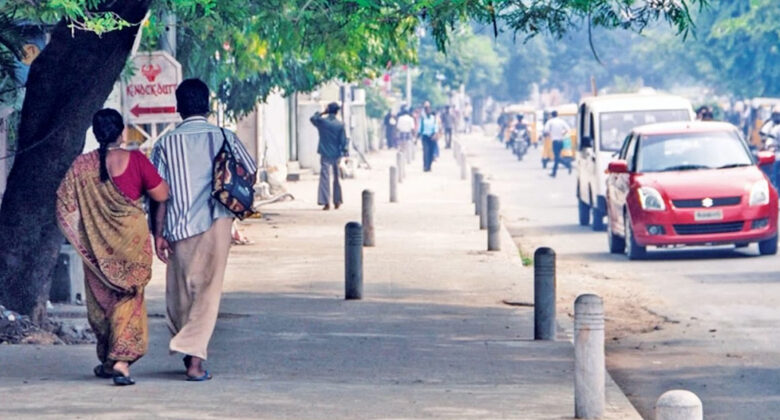
New Delhi: In a landmark judgment, the Supreme Court has declared that the right to walk safely on properly demarcated and maintained footpaths is a fundamental right under the Constitution, and that this right takes precedence over the movement of motorised vehicles.
Delivering the judgment, Justice P.S. Narasimha stated that whenever a road exists, authorities have a corresponding duty to provide and maintain safe footpaths for pedestrians. He emphasized that this obligation is enforceable and that the fundamental right of pedestrians must override the privilege enjoyed by motor vehicles.


The ruling arose from a tragic case involving the death of a five-year-old boy who was run over by a truck while walking to school with his father.
Justice Narasimha observed that walking is one of the most basic human activities and is intrinsically linked to the right to life. He noted that the Constitution guarantees freedom of movement throughout India, and this includes the right to walk safely in public spaces.
The Court criticized decades of development policies that prioritized roads, highways, and motor vehicles while neglecting pedestrian infrastructure. It remarked that rapid urbanisation and economic growth have increasingly marginalized pedestrians, often treating them as obstacles rather than rightful users of public spaces.
According to the judgment, common public spaces should not be monopolized by motor vehicles. The Court questioned why municipal authorities fail to provide adequate footpaths despite the minimal effort and resources required compared to large-scale road projects.
Justice Narasimha also highlighted the cultural, political, social, and historical significance of walking in India. He noted that walking has served as a means of social reform, political resistance, spiritual reflection, and collective action, including during the freedom movement.
The Court further observed that walking is connected not only to freedom of movement but also to the constitutional rights of expression, assembly, and association under Article 19.
Criticizing the Motor Vehicles Act, 1988, the judgment stated that the law focuses primarily on vehicles, while pedestrian interests receive only incidental protection. The Court said the existing legal framework fails to adequately recognize and safeguard the rights of walkers.
To address this gap, the Supreme Court called for a comprehensive statutory framework dedicated to protecting the right to walk. It recommended the creation of a specialized regulatory authority responsible for planning, enforcing, and implementing pedestrian rights, as well as providing swift remedies for violations.
The Court directed its Registry to forward copies of the judgment to the Ministries of Housing and Urban Affairs, Rural Development, and Road Transport and Highways, urging them to consider drafting appropriate legislation. It also requested the Law Commission of India to examine the need for a legal framework that clearly identifies responsibilities and enforcement mechanisms.
While awarding compensation of more than ₹11 lakh to the bereaved father, Justice Narasimha reflected on the tragedy that led to the case. He noted the heartbreaking reality that what began as a routine walk to school became the father’s final journey with his young son.
The judgment concludes by reaffirming that constitutional courts have a continuing duty to recognize and protect the fundamental right of every citizen to walk safely on demarcated footpaths.