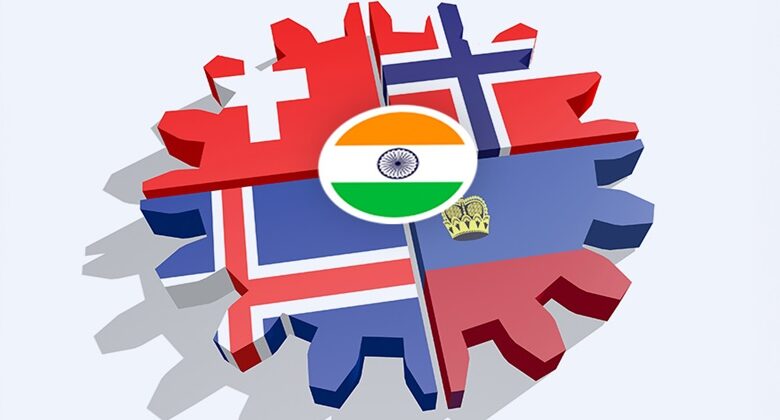
India is set to formally operationalise its trade agreement with the European Free Trade Association (EFTA) bloc on October 1, marking the country’s first-ever trade pact with a European grouping. The government will host a high-profile launch event at Bharat Mandapam in New Delhi, with Commerce and Industry Minister Piyush Goyal, senior ministers from the EFTA nations, government officials, and industry representatives in attendance, as per the national media.
The four-nation bloc consists of Iceland, Liechtenstein, Norway, and Switzerland. India and EFTA had signed the Trade and Economic Partnership Agreement (TEPA) on March 10, 2024, but the deal’s implementation was delayed by procedural approvals in the member countries.


Government officials said the launch is not just ceremonial but also aimed at outreach. “The idea also is to ensure that industry stakeholders are aware of the deal and well-positioned to take full advantage of it,” a senior official informed.
The TEPA is unique in India’s trade diplomacy for several reasons. It is the first trade agreement that New Delhi has signed with a European bloc, and also the first where market access commitments are directly tied to investment pledges.
India has agreed to cut tariffs to zero on 80–85 per cent of goods imported from EFTA countries. In return, Indian exporters will enjoy duty-free access to 99 per cent of goods in EFTA markets. Sensitive sectors, especially agriculture and dairy, have been kept out of the tariff concessions to safeguard domestic farmers.
What stands out in this agreement is the scale of investment promised by the EFTA bloc. The four countries have committed to channel $50 billion into India within the first 10 years of the deal coming into force, followed by another $50 billion in the subsequent five years. The government estimates that this could help generate one million direct jobs in India over 15 years.
Unlike India’s other trading partners, the EFTA countries already maintain low import tariffs. This means that India’s immediate gains on market access could be modest. However, the investment-linked design of the pact is seen as a way to ensure mutual benefits.
The EFTA deal’s significance lies in India finally breaking through with a European partner. It demonstrates a strategic shift: rather than focusing solely on tariff cuts, India is securing investment that can spur long-term industrial growth and employment at home.