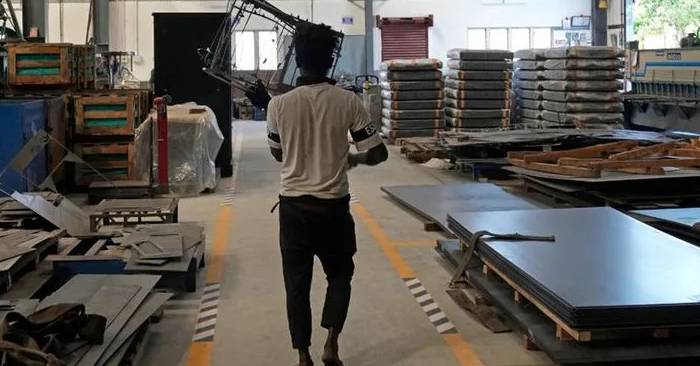
The recent announcement by former US President Donald Trump to impose a 25 percent tariff on steel imports has sparked mixed reactions within India’s steel industry. While some businesses anticipate benefits from lower steel prices, others fear an influx of cheap imports, increased competition, and environmental consequences.
In Bengaluru, where steel products are used in everything from car parts to household appliances, smaller manufacturers hope to see an improvement in their profit margins. B. Praveen, the owner of Sun Techpro Engineering, expressed optimism, stating that cheaper steel could lead to reduced production costs for businesses like his.


However, industry leaders are concerned about steel dumping, as major steel-producing countries like China and South Korea may redirect their excess steel to India, one of the few markets without strict import regulations. Naveen Jindal, president of the Indian Steel Association, warned that an unchecked flood of imports could undercut domestic manufacturers and delay India’s transition to sustainable steel production.
India’s growing economy and rapid urbanization have pushed demand for steel higher, with the government setting ambitious targets to increase production from 120 million tonnes to 300 million tonnes in the next five years. While this expansion aims to support industrial growth, the environmental implications are a growing concern.
Steel manufacturing is a major source of carbon emissions, contributing nearly 12% of India’s total emissions. With increased production, this figure could double unless the industry shifts toward cleaner technologies. While the Indian government has committed $1.72 billion to green steel initiatives, many new expansion projects continue to rely on coal-based blast furnaces, which are highly polluting.
This dependence on coal-based production could also harm India’s global competitiveness. The European Union’s Carbon Border Adjustment Mechanism (CBAM) will impose carbon taxes on imports based on their emissions levels, making Indian steel exports more expensive compared to cleaner alternatives from China and other regions. Easwaran Narassimhan, an expert at the Sustainable Futures Collective, emphasized that India’s carbon-intensive steelmaking could struggle to compete in European markets.
Despite these challenges, India has committed to achieving net-zero emissions by 2070 and increasing its renewable energy capacity. However, steelmakers remain cautious about the financial burden of decarbonization. Prabodh Acharya, the chief sustainability officer at JSW Group, noted that while transitioning to green steel is essential, it must be economically viable for businesses to survive.
As India navigates this complex landscape, balancing economic growth, environmental sustainability, and global trade dynamics will be crucial in determining the future of its steel industry.