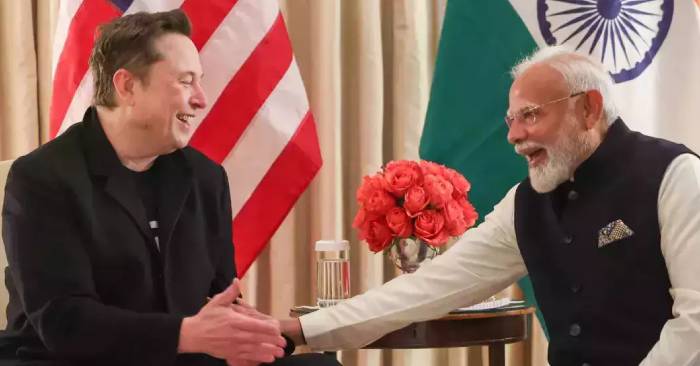
American electric vehicle giant Tesla is gearing up for its long-anticipated entry into the Indian market, with plans to launch retail operations by April this year. The company has already started hiring for various positions, including business operations analysts and customer support specialists, indicating an imminent expansion.
According to reports, Tesla will initially import cars from its Berlin factory in Germany, aligning with the Indian government’s request to avoid imports from China due to ongoing diplomatic tensions. The Berlin plant, which produces Tesla Model Y, will manufacture right-hand drive vehicles specifically for the Indian market.


Tesla’s ambitious plans include setting up a manufacturing facility with a production capacity of 5 lakh vehicles annually. The company is expected to invest between $2 billion and $3 billion in this project. As part of its proposal to the Indian government, Tesla aims to launch a budget-friendly electric car in India, priced between ₹20-25 lakh, making its vehicles more accessible to Indian consumers.
The announcement has sparked intense competition among Indian states, with Maharashtra, Tamil Nadu, and Gujarat emerging as frontrunners to host Tesla’s factory. These states, known for their strong automotive industry presence, also offer strategic advantages, including easy access to ports for exports. Reports suggest that state governments are keen to attract Tesla by offering incentives and negotiating favorable terms.
Tesla is also expected to take advantage of India’s new EV policy introduced in March 2024. This policy allows automakers to import up to 8,000 electric cars annually at a significantly reduced customs duty of 15%—a sharp reduction from the current 110%—provided the company commits to investing at least ₹4,150 crore ($500 million) in a local manufacturing plant and adheres to domestic value addition (DVA) requirements.
Elon Musk has long maintained that Tesla would only establish a manufacturing unit in India if it is first allowed to sell and service its vehicles in the country. In 2021, Musk had criticized India’s high import duties, calling them the highest in the world among major economies. Currently, fully built imported cars (CBUs) face customs duties ranging from 70% to 100%, making Tesla’s EVs prohibitively expensive for most Indian buyers.
With Tesla’s potential investment, India’s EV market is poised for a major transformation. As the company finalizes its plans, all eyes will be on which state successfully secures the much-coveted Tesla factory.