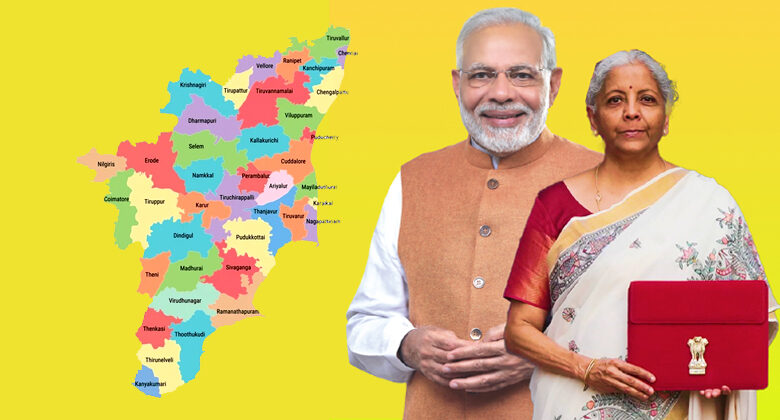
The recent Union Budget presented by Nirmala Sitharaman lays out an expansive plan to strengthen Tamil Nadu’s infrastructure, industry, and cultural landscape. The scale of allocations and new project announcements signals a renewed push by the Central Government to accelerate the state’s economic momentum.
Infrastructure and Railway Expansion


Transport connectivity remains central to long-term growth, and the budget underscores this priority.
Two high-speed rail corridors have been proposed: the Chennai–Bengaluru route and the Hyderabad–Chennai corridor. These links are expected to significantly cut travel time between major southern economic hubs, facilitating smoother movement of people and goods while encouraging investment across industries.
Railway funding for Tamil Nadu has also increased sharply. During the UPA years, the state received an average of ₹879 crore annually for railway development. Current allocations now exceed ₹6,600 crore. This substantial rise is expected to fast-track track doubling, station redevelopment, safety upgrades, and other long-pending improvements.
Boost to Industry and Employment
The budget outlines targeted initiatives to strengthen manufacturing and technology-driven growth.
A ₹10,000 crore fund has been proposed to support Micro, Small and Medium Enterprises (MSMEs). Industrial centres such as Coimbatore and Tiruchirappalli are likely to benefit from improved access to credit and operational assistance. Given the critical role MSMEs play in employment generation, enhanced liquidity could stimulate expansion and job creation.
Tamil Nadu has also been identified as a key participant in the Indian Semiconductor Mission. The next phase of the programme is expected to attract semiconductor design and manufacturing investments, potentially opening new opportunities for engineers and skilled professionals, particularly in and around Chennai’s technology clusters.
Traditional industries have received attention as well. The budget includes incentives for textile production and targeted support for coconut and cashew farmers. The Marine Fisheries project has been prioritised to strengthen infrastructure and improve livelihoods in coastal regions.
Cultural and Tourism Development
Beyond industry, the budget highlights heritage preservation and sustainable tourism.
Adichanallur is set to be developed into a major cultural destination, including the establishment of an on-site museum. This initiative aims to promote research, preserve historical heritage, and boost tourism.
Eco-tourism initiatives are also on the agenda. A proposed bird trail at Pulicat Lake and a trekking trail in Kolli Hills are designed to encourage sustainable travel while generating income for local communities.
Implementation and Political Debate
While the announcements have generated interest, execution remains crucial. Observers highlight potential challenges such as land acquisition delays and administrative clearances that could slow infrastructure rollout.
Political differences have also surfaced regarding credit for welfare and development schemes. Representatives from the Centre have raised concerns about the visibility of centrally funded programmes, while the state government emphasises the importance of cooperative federalism and joint implementation.
Industry Outlook
Industry stakeholders across Tamil Nadu have largely welcomed the proposals. Technology professionals see the semiconductor initiative as a gateway to global investment. MSME associations in Coimbatore have praised the proposed fund for improving financial access. Trade bodies in cities such as Madurai, Tirunelveli, Salem, and Tiruchirappalli believe enhanced rail connectivity will lower logistics costs and strengthen regional commerce.
Overall, the Union Budget outlines a broad strategy to position Tamil Nadu as a major engine of India’s economic growth. Infrastructure upgrades, industrial incentives, and cultural investments together reflect a comprehensive development vision. The true impact, however, will depend on timely and effective implementation.