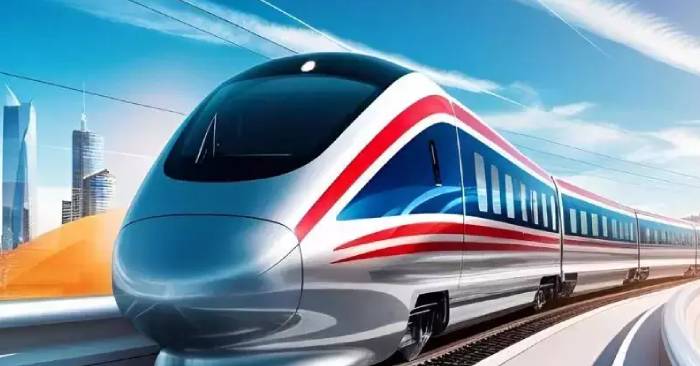
India is set to take a major leap in futuristic transportation by building the world’s longest hyperloop test track, a project backed by Indian Railways. The ambitious initiative follows the successful completion of a 422-meter hyperloop test facility in December 2024. This new 40-50 km test track aims to evaluate the commercial feasibility of hyperloop technology, which has the potential to achieve speeds of up to 1,100 km/h, significantly enhancing transport efficiency.
A senior official confirmed to the Economic Times that Indian Railways is actively supporting this venture, underscoring the government’s commitment to revolutionizing mass transit in the country. Hyperloop technology involves transport capsules that move through low-pressure vacuum tubes using air-bearing surfaces, offering an energy-efficient and cost-effective solution for long-distance travel.


The 422-meter vacuum tube testing facility was developed through a collaborative effort involving L&T Construction, Indian Railways, and Avishkar Hyperloop at IIT Madras. Building on this success, TuTr Hyperloop, a deep-tech startup from IIT Madras, conducted India’s first hyperloop pod operation with commercial intent.
Additionally, Indian Railways and IIT Madras are set to work together on developing a vertical take-off and landing (VTOL) vehicle, which will be funded by Indian Railways. Industry experts believe that India holds immense potential for hyperloop adoption, with the estimated cost of the 40-km test track ranging between $150 million and $300 million, depending on project dimensions.
Denis Tudor, CEO and Co-founder of Swisspod Technologies, highlighted India’s growing influence in hyperloop research and its potential for widespread implementation. Meanwhile, China is also exploring similar high-speed transit systems, aiming to achieve hypersonic travel speeds.
This initiative marks a significant step toward modernizing India’s transportation infrastructure, positioning the country at the forefront of next-generation transit solutions. If successful, hyperloop technology could redefine travel efficiency, reduce congestion, and provide an ultra-fast alternative to traditional rail and air travel.