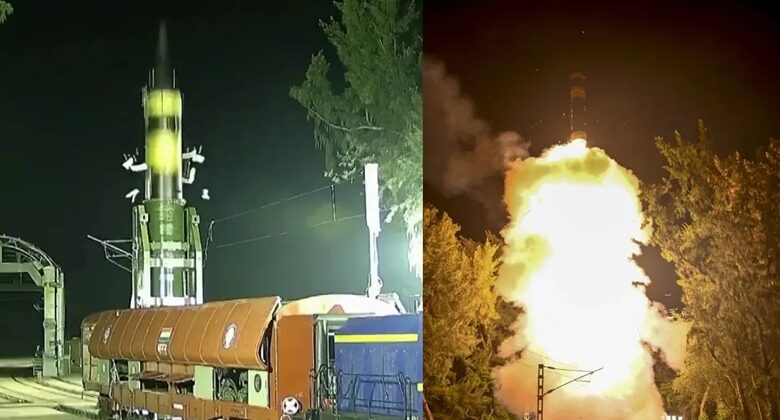
India has successfully carried out the launch of the intermediate-range quasi-ballistic nuclear missile “Agni-Prime” from a rail-based mobile launcher system that allows the military to have cross-country mobility and launch within a short reaction time with reduced visibility.
The first-of-its-kind launch carried out from the specially designed Rail-based Mobile Launcher gives the military the capability to move on a rail network without any preconditions. This means that the missile, which has a range of 2,000 kilometres, is literally a missile on the go.


This means that it can be fired even as it is being transported from one location to the other using the specialised mobile launcher. It is self-sustained and is equipped with all independent launch capability features, including state-of-the-art communication systems and protection mechanisms.
“This successful flight test has put India in the group of select nations having capabilities that have developed a canisterised launch system from the mobile rail network,” Defence Minister Rajnath Singh said in a statement, congratulating the Defence Research and Development Organisation (DRDO), the Armed Forces, and the Strategic Forces Command, which is in charge of India’s nuclear arsenal. With this, India can launch a nuclear missile from under the sea, surface, air, and now from a railway network.
The Agni-Prime, initially named Agni-1P, weighs 50 per cent less than Agni 3, and has many advanced features. Unlike the other nuclear missiles in India’s arsenal, Agni-Prime comes with its own unique technology, giving it more accuracy while making it difficult to intercept. It can be manoeuvred at the point of entry into the earth’s atmosphere—a feature that is usually not available in a ballistic missile. This makes the Agni-Prime more difficult to intercept.
Another key aspect of this next-generation missile that makes it special is that it has a canisterised system, meaning the SFC has mode options when it comes to movement and launch. The two-stage solid-fuelled weapon system comes with new propulsion systems, composite motor casings, and inertial navigation systems based on advanced ring-laser gyroscopes.
Gyroscopes show the location of the missile and the trajectory it is taking. The ring-laser gyroscopes are more accurate. While it has been popularly believed that Agni-Prime would replace Prithvi, Agni 1 and Agni 2 series of ballistic nuclear missiles.