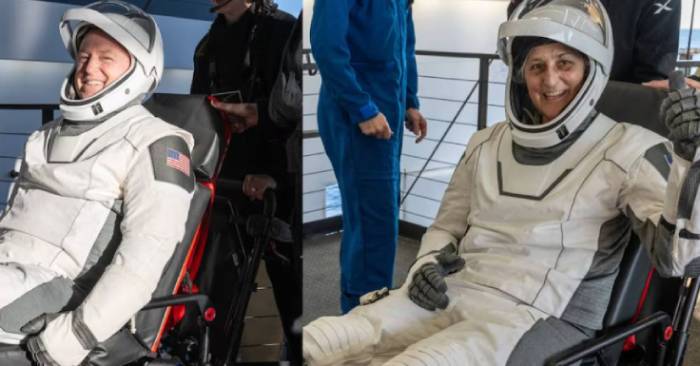
NASA astronauts Sunita Williams and Butch Wilmore have safely returned to Earth after an extended 286-day mission aboard the International Space Station (ISS). Their journey, which began as a short-term test flight on Boeing’s Starliner spacecraft, turned into an unexpectedly long stay due to technical issues. Alongside fellow astronauts Nick Hague and Aleksandr Gorbunov, the duo landed off the Florida coast on Tuesday aboard SpaceX’s Crew Dragon capsule, marking the end of a mission that captured worldwide attention.
The spacecraft, named Freedom, endured extreme re-entry temperatures before deploying parachutes and making a controlled splashdown. As recovery teams rushed to the capsule, a pod of dolphins provided an unexpected welcome. Soon after, the astronauts were carefully assisted out and transported to Houston, where they will undergo a rehabilitation program to readjust to Earth’s gravity.


Williams and Wilmore’s prolonged stay raised questions about space mission contingency planning and astronaut endurance. Despite the physical and psychological challenges, experts noted that their time in orbit aligns with established long-duration mission protocols. The astronauts’ resilience in handling the situation has been widely praised.
Their extended mission also became a subject of political debate, with former President Donald Trump and SpaceX CEO Elon Musk alleging that the astronauts were neglected. However, NASA officials emphasized that their return was carried out according to a well-established plan. Regardless of the controversy, the mission underscores the unpredictability of space travel and the adaptability required for long-term human spaceflight.