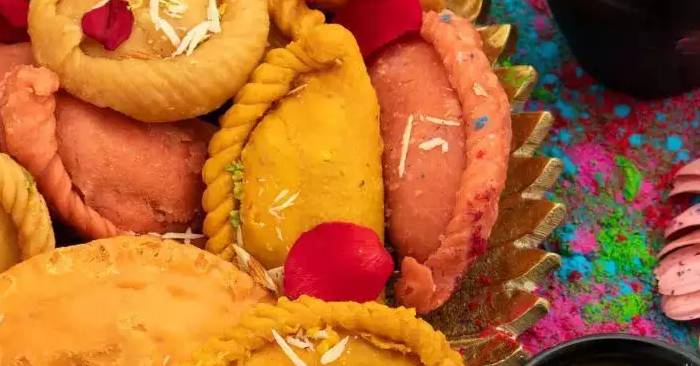
As Holi 2025 approaches, the delightful aroma of freshly fried gujiyas fills Indian homes, signaling the arrival of the festival of colors. This crescent-shaped, deep-fried pastry, filled with khoya, dry fruits, and nuts, has become synonymous with Holi celebrations. However, its origins stretch far beyond Indian kitchens, drawing influence from Turkish baklava and ancient Indian confections. The journey of gujiya is a fascinating tale of cultural fusion, culinary evolution, and religious significance.
Tracing the Origins: From Ancient India to the Silk Route
The history of gujiya dates back to ancient India, with early mentions of a similar sweet, karanika, in Sanskrit texts. This delicacy, made with dry fruits and honey, is believed to be the earliest version of the gujiya. Archaeological evidence suggests that crescent-shaped sweets were popular during the Mauryan era (322 BC – 185 BC), possibly due to their easy preservation. By the 13th century, historical records describe a sun-dried version of this treat, indicating early techniques for extending its shelf life.


Turkish Influence and the Evolution of Gujiya
One of the most intriguing theories about gujiya’s development connects it to Turkish baklava. Both sweets share similarities—flour-based exteriors stuffed with dry fruits and nuts. While baklava is layered with butter and soaked in syrup, gujiya evolved into a deep-fried pastry with a sturdier wheat casing. Historians suggest that this influence came through the Silk Route, where traders exchanged not just goods but also culinary traditions. Indian traders may have adapted the flaky Turkish pastry using local ingredients like khoya, ghee, and indigenous spices, shaping the gujiya we love today.
Mughal Refinements and Royal Enhancements
During the Mughal era (16th–18th century), gujiya became a more refined delicacy. The introduction of khoya as a primary filling ingredient can be traced back to this period, elevating its richness. The Mughals also introduced saffron, cardamom, and almonds into Indian sweets, further enhancing gujiya’s flavor. Royal kitchens experimented with variations, making the sweet a luxurious treat for special occasions and festive gatherings.
Gujiya and its Spiritual Connection to Holi
The deep-rooted connection between gujiya and Holi can be found in Hindu mythology, particularly in stories of Lord Krishna. In Vrindavan, Krishna’s childhood home, gujiyas have been offered as prasad in temples for centuries. The Radha Raman temple, built in 1542 AD, continues the tradition of distributing gujiyas and chandrakala (a similar sweet) during Holi. This link between the sweet and Krishna’s playful spirit solidified its role in Holi celebrations, making it an essential festive treat.
Regional Variations: A Unique Twist in Every State
As gujiya spread across India, different regions created their own unique adaptations:
Bihar: Known as pedakiya, it often includes coconut in the filling.
Gujarat: Called ghughra, it features slight variations in texture and sweetness.
Maharashtra: Karanji is the state’s version, incorporating poppy seeds and coconut.
Tamil Nadu & Karnataka: Somas and karjikayi use coconut-heavy fillings with a South Indian touch.
Rajasthan: Developed chandrakala and suryakala, ornate variations of gujiya.
Awadh (Uttar Pradesh): Once known for Dahi ki Gujiya, which included yogurt, nuts, and cardamom.
Punjab: Palakari, a softer-centred version, is dipped in jaggery syrup instead of sugar.
Gujiya in Modern Times
Today, gujiya is more than just a sweet—it’s a symbol of Holi celebrations, gifted among families and friends as a gesture of goodwill. While traditional khoya-filled gujiyas remain a favorite, contemporary versions have emerged. Innovations like chocolate gujiyas, fruit-infused fillings, and even baked versions cater to modern tastes and health-conscious individuals.
Despite these adaptations, the essence of gujiya-making remains a cherished family tradition. The process of kneading the dough, filling the pastry, crimping the edges, and frying them to golden perfection brings generations together, making it an integral part of Holi’s festive spirit. Whether enjoyed in its classic form or with a modern twist, gujiya continues to be a timeless treat that bridges history, culture, and celebration.