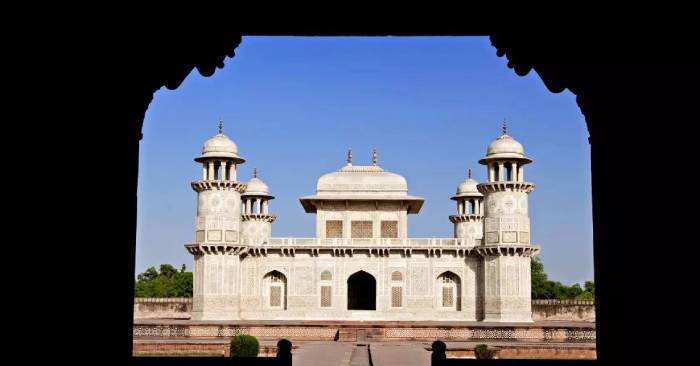
Situated on the eastern bank of the Yamuna River, the Itimad-ud-Daulah mausoleum, often referred to as the “Baby Taj,” is an exquisite Mughal monument in Agra that significantly influenced the design of the Taj Mahal. Although Agra is famed for the iconic Taj Mahal, this lesser-known marble masterpiece offers a glimpse into the Mughal Empire’s architectural evolution and serves as a precursor to the Taj Mahal’s grandeur.
Constructed in the early 17th century, the Itimad-ud-Daulah was commissioned by Nur Jahan, the influential empress of Mughal Emperor Jahangir, in memory of her father, Mirza Ghiyas Beg, who was honored with the title Itimad-ud-Daulah, meaning ‘pillar of the state.’ The mausoleum was built between 1622 and 1628, following the death of Ghiyas Beg and his wife, both of whom are interred within its confines.


The Itimad-ud-Daulah complex stands out for its white marble structure and intricate inlay work, showcasing floral designs, geometric patterns, and calligraphic elements. The main tomb, with its central chamber, houses the cenotaphs of Itimad-ud-Daulah and his wife, while additional tombs for Nur Jahan’s other relatives are positioned in corner rooms. Unlike the Taj Mahal, which is famed for its grand scale and opulence, the Itimad-ud-Daulah offers a more intimate and refined architectural experience, yet its design principles, such as the use of marble and elaborate jali screens, foreshadow the later grandeur of the Taj Mahal.