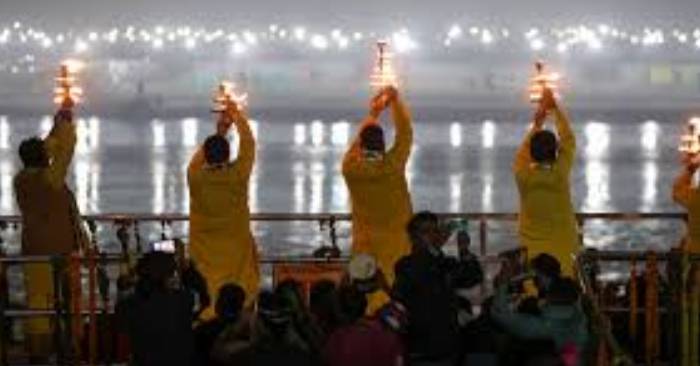
The grand Maha Kumbh 2025 is set to conclude today with the final Mahashivratri snan (holy dip) in the sacred waters of the Ganga in Prayagraj. Over the past 45 days, this spiritually significant festival has witnessed a record-breaking 65 crore devotees, making it the largest religious gathering in history.
This once-in-a-lifetime event, occurring due to the rare alignment of four planets, has not only reaffirmed India’s deep-rooted spiritual traditions but also proved to be a major economic catalyst for Uttar Pradesh’s vision of a ₹1 trillion economy. According to Chief Minister Yogi Adityanath, Maha Kumbh 2025 is expected to contribute over ₹3 lakh crore to the state’s economy, significantly surpassing the ₹1.2 lakh crore revenue of the 2019 Kumbh Mela.


The festival has attracted businesses from FMCG, fintech, and tech startups, leveraging the massive footfall to expand their market reach. With an initial ₹5,000 crore investment, the government anticipates exponential returns, highlighting the power of religious tourism in driving economic growth.
However, Maha Kumbh 2025 has not been without controversy. West Bengal CM Mamata Banerjee and religious leaders like Swami Avimukteshwaranand Saraswati have questioned the 144-year cycle claim and criticized the lack of crowd management following tragic stampedes. The BJP has dismissed these claims as politically motivated, defending the festival’s legitimacy based on historical and astrological records.
Despite debates, Maha Kumbh 2025 stands as a monumental spiritual and economic event, reinforcing India’s position as a global hub for religious tourism while setting new benchmarks for economic impact.