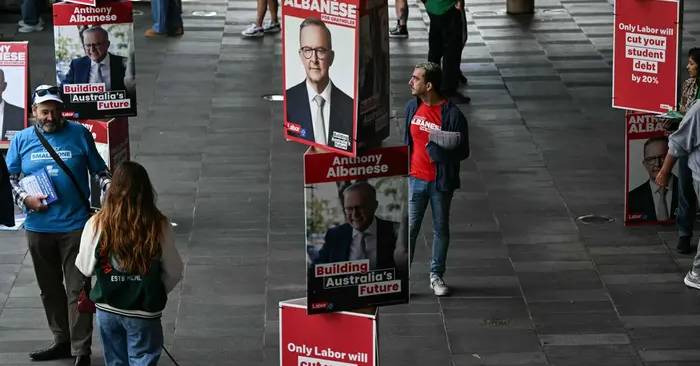
Australia is holding a critical general election, with voters deciding between current Prime Minister Anthony Albanese and opposition leader Peter Dutton. The election has been shaped by sharp divisions on issues such as energy strategy, economic management, and foreign policy, with both leaders offering contrasting paths forward.
Anthony Albanese, leader of the center-left Labor Party, and Peter Dutton of the conservative Liberal Party both come from humble beginnings. Albanese, raised by a single mother in public housing, built his political career advocating for social equity. Dutton, once a police officer and the son of a bricklayer, is known for his tough approach to law enforcement and national security.


Energy policy has emerged as a central issue. Dutton has vowed to end Australia’s decades-long ban on nuclear energy, promoting it as the most reliable low-emission option. In contrast, Albanese has doubled down on Australia’s transition to renewables, investing in solar, wind, and green industries to make the country a global leader in clean energy.
The election has also been influenced by foreign relations, particularly trade tensions with the U.S. following tariff threats under Donald Trump. Dutton has praised Trump in the past, though he now says he would not hesitate to stand up to global leaders for Australia’s interests. Albanese criticized the tariffs as damaging and reaffirmed his commitment to fair trade.
A surge in support for climate-conscious and transparency-driven independents has introduced the possibility of a hung parliament, with up to 10 crossbenchers potentially holding the balance of power.
Voting is mandatory in Australia, with over 90% turnout expected from the 18.1 million registered voters. More than a third have already voted early. The election will determine all 150 seats in the House of Representatives and 40 of the 76 Senate seats. While Labor held a slim majority before the election, a close result could reshape the power dynamics in Canberra.