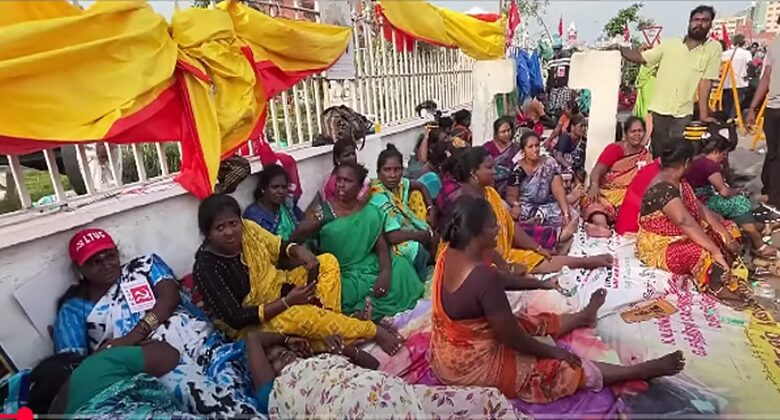
A police crackdown on Sanitation Workers’ peaceful protest for livelihood rights has sparked outrage across Tamil Nadu. The DMK, which once campaigned on the promise “We stand for workers,” now finds itself accused of betraying that very pledge. On the heels of a court directive, police swooped in and detained hundreds of workers without warning.
Women, the elderly, and long-serving daily wage earners were forcibly removed. Disturbing Pictures of exhausted workers collapsing and being dragged away by officers have flooded social media, fueling public anger across the state.


In 2021, the DMK manifesto promised permanent jobs, fair wages, and safe working conditions for sanitation workers. Three years later, those assurances remain unfulfilled: Efforts to grant permanent jobs remain tied up in litigation, with cases filed by workers gathering dust. Despite repeated assurances, civic services are still outsourced to private contractors, eroding job security.
Government orders on minimum pay are ignored in practice, leaving thousands of workers underpaid. For many workers, the dream of stability has given way to deepening insecurity. Opposition leader Edappadi K. Palaniswami minced no words, accusing the DMK of double standards. “When in opposition, the DMK staged protests over the smallest issues.
In power, it stays silent or unleashes police on genuine struggles,” he said. Critics highlight that during the 13-day protest, the government neither opened dialogue nor addressed grievances. “One face before elections, another after power – the hypocrisy is visible to all,” Palaniswami charged.
In the aftermath of the crackdown, the government rushed to announce schemes, including free breakfast, housing support, and insurance coverage. Yet the central demand for permanent government jobs was conspicuously left out. Workers and activists alike dismissed the move as window dressing. “Announcing schemes without addressing the core issue is an insult,” said one union leader. The controversy has also thrown a harsh spotlight on Chennai’s worsening civic health.
Once hailed as one of India’s cleanest metros, the city has now plummeted to 38th place in the Swachh Survekshan 2024-25 rankings. The city generates 6,500 tonnes of garbage daily, yet door-to-door collection covers barely half its households. Functional public toilets, once at 77 per cent, have plummeted to just 33 per cent. In neighbourhoods like Nungambakkam, waste piles up until afternoon, forcing residents to endure stench and neglect.
While Indore secured a 7-star cleanliness rating, Chennai failed to earn even one. Mayor Priya defended the privatisation model, claiming, “Privatisation is the only way to keep Chennai clean.” But with 10 of the city’s 15 zones under private contractors, the results are damning: job losses, falling wages, and deteriorating civic standards. Workers who once earned ₹23,000 now survive on ₹15,000. Once proudly hailed as the “Detroit of India,” Chennai today stands buried under the weight of mismanagement, broken promises, and uncollected garbage.