KABUL: Afghanistan’s worst earthquakes killed more than 800 people and injured at least 2,800, authorities confirmed to an international news agency. The disaster will further stretch the resources of the war-torn nation’s Taliban administration, already grappling with crises ranging from a sharp drop in foreign aid to deportations of hundreds of thousands of Afghans by neighbouring countries.
Sharafat Zaman, spokesperson for the health ministry in Kabul, called for international aid to tackle the devastation caused by the earthquake of magnitude 6 that struck around midnight local time, at a depth of 10 km (6 miles). The quake killed 812 people in the eastern provinces of Kunar and Nangarhar, administration spokesperson Zabihullah Mujahid said.


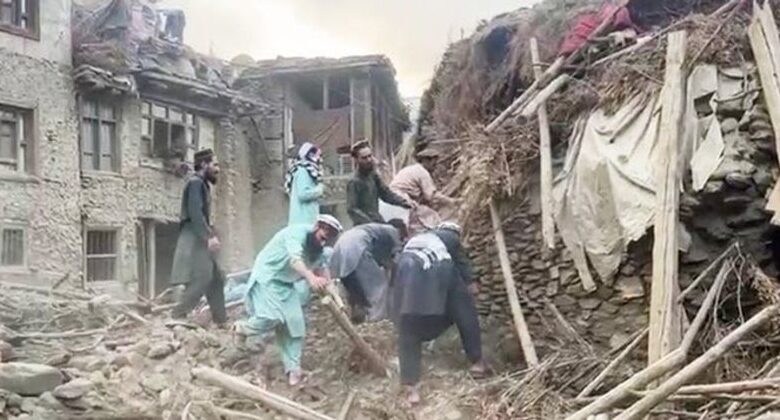
Ziaul Haq Mohammadi, a student at Al-Falah University in the eastern city of Jalalabad, was studying in his room at home when the quake struck. He said he tried to stand up but was knocked over by the power of the tremor. Rescuers were battling to reach remote mountainous areas cut off from mobile networks along the Pakistani border, where mudbrick homes dotting the slopes collapsed in the quake.
Rescue teams and authorities are trying to dispose of animal carcasses quickly to minimise the risk of contamination to water resources, said. Military rescue teams fanned out across the region, the defence ministry said, with 40 flights carrying away 420 wounded and dead. The quake razed three villages in Kunar, with substantial damage in many others, authorities said. At least 610 people were killed in Kunar, with 12 dead in Nangarhar, they added.
Some villagers sat weeping amid the piled ruins of their homes. Others began laboriously clearing the debris by hand, or carried out the injured on makeshift stretchers. Diplomats and aid officials say crises elsewhere in the world, along with donor frustration over the Taliban’s policies towards women, including curbs on those who are aid workers, have spurred the cuts in funding. Even humanitarian aid, aimed at bypassing political institutions to serve urgent needs, has shrunk to $767 million this year, down from $3.8 billion in 2022.