As Tamil Nadu moves steadily toward the 2026 Assembly elections, the state’s political climate is heating up. From Chennai’s busy corridors to the temple towns of the south and the agrarian regions of the north, a distinct storyline is emerging: the National Democratic Alliance (NDA) is no longer on the margins. Instead, it is shaping up as a cohesive, disciplined and credible challenger aiming to alter the state’s long-standing political order.
Led jointly by the BJP and the AIADMK, the NDA has moved with speed and purpose—strengthening its base, widening its organisational reach and projecting a sense of stability and preparedness. What was once perceived as a fragmented alliance now appears increasingly unified and battle-ready.


Groundwork and Alliance Consolidation
A pivotal moment came in December 2025, when AIADMK general secretary Edappadi K. Palaniswami met senior BJP leader Piyush Goyal at the AIADMK headquarters in Chennai. The discussions, which reportedly covered all 234 Assembly constituencies, went well beyond symbolism. They marked the start of coordinated planning at both leadership and grassroots levels.
Equally notable has been the growing synergy between BJP and AIADMK cadres. Booth-level workers—earlier divided by mistrust—are now collaborating on voter outreach, data sharing and campaign execution. In a state where elections are often decided by narrow margins, this organisational alignment could prove crucial.
The NDA’s momentum received a significant boost with the PMK formally joining the alliance. PMK leader Anbumani Ramadoss’ public show of unity with EPS and BJP leaders at Salem on January 6, 2026, sent a strong message, particularly in northern Tamil Nadu. The PMK’s entry is widely viewed as consolidating Vanniyar support, a decisive factor in several constituencies.
Leadership Push and Cadre Energy
The BJP has made its intent to contest the 2026 elections aggressively unmistakable. Union Home Minister Amit Shah’s roadshows and review meetings in Chennai and Trichy in early January injected fresh energy into the cadre and reaffirmed the party’s commitment to Tamil Nadu.
Another major initiative, the statewide “Our Town Modi Pongal” campaign led by BJP National Working President Nitin Nabin, saw strong participation across districts. Drawing in large numbers of youth and women, the campaign reflected Prime Minister Narendra Modi’s expanding appeal beyond traditional urban strongholds.
Party sources indicate that BJP membership in Tamil Nadu has nearly doubled over the past year, pointing to a steady strengthening of its grassroots machinery—an organisational advantage that could play a decisive role in 2026.
The Modi Factor
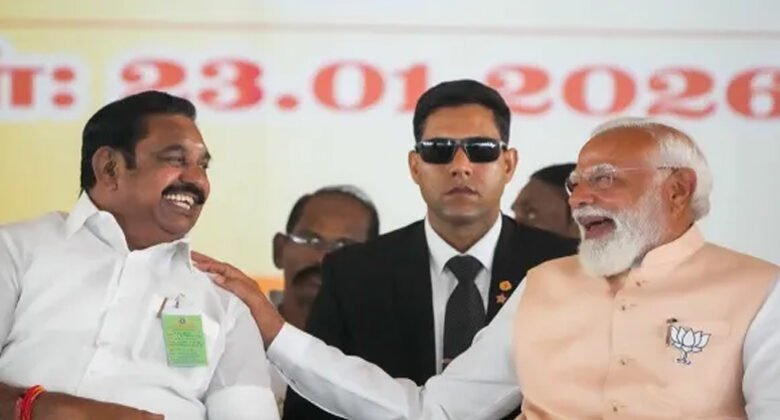
Prime Minister Modi’s scheduled appearance at the NDA’s mega conference in Madurantakam on January 23 has generated significant political buzz. The choice of a venue near Chennai ensures statewide attention, with leaders from all alliance partners expected to be present.
Beyond the symbolism, the visit carries a strong policy focus. The inauguration of MSME clusters and irrigation projects highlights the NDA’s emphasis on employment generation and agricultural development. Strategically, the event is seen as a counterpoint to the DMK’s Karunanidhi centenary celebrations, positioning voters between legacy-driven politics and performance-oriented governance.
During his recent Tamil Nadu visit, Nitin Nabin further reinforced this momentum. After receiving an enthusiastic welcome in Coimbatore, he visited prominent temples and chaired a key strategy meeting. Discussions centred on identifying winnable seats, finalising candidates, strengthening booth committees and sharpening communication around central schemes such as PM-KISAN, housing programmes and welfare initiatives.
Strains Within the DMK Alliance
In contrast, the DMK-led front is facing visible internal tensions. Seat-sharing disagreements with the Congress have intensified, with indications that the Congress’ allocation may be reduced significantly. Congress leaders have openly expressed dissatisfaction, alleging that the DMK treats them as little more than a support base.
Statements by DMK leaders suggesting the inevitability of single-party dominance have further unsettled allies. Added to this are differences over cultural and political issues, including disputes involving film personalities and national leadership. Observers note that such public discord risks diluting the ruling alliance’s campaign narrative.
Road to 2026
The NDA’s electoral strategy rests on a mix of governance credentials and political clarity. Rural welfare schemes like PM-KISAN, visible infrastructure initiatives such as Vande Bharat trains, and persistent allegations of corruption against the DMK form the core of its pitch.
Recent opinion surveys suggest that youth support—long considered a DMK strength—may be weakening. Against the backdrop of uncertainty within the ruling coalition, the NDA’s growing unity, organisational discipline and strategic focus present an increasingly compelling alternative.
As the 2026 Assembly election draws closer, the NDA’s message is clear: Tamil Nadu stands at the threshold of change—one rooted in development, accountability and a new political direction.