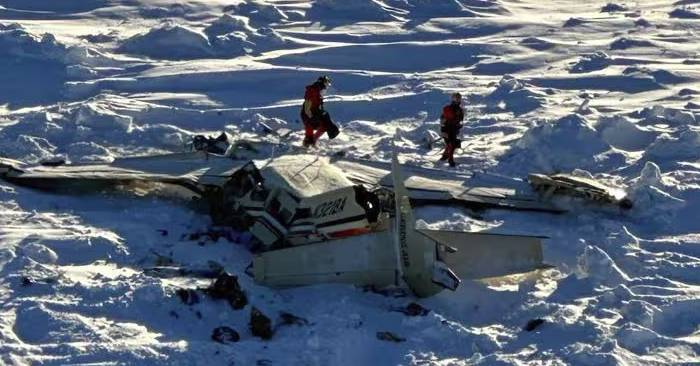
A small commuter plane that vanished while flying from Unalakleet to Nome in western Alaska was discovered on Friday on sea ice, with all 10 people aboard confirmed dead, authorities reported. The aircraft, operated by Bering Air, had nine passengers and a pilot on board when it took off on Thursday afternoon but lost contact less than an hour later.
According to Mike Salerno, a spokesperson for the U.S. Coast Guard, a search-and-rescue helicopter located the wreckage approximately 12 miles (19 kilometers) offshore from Nome. Two rescue swimmers were deployed to assess the crash site. David Olson, Bering Air’s director of operations, stated that the aircraft, a Cessna Caravan, took off at 2:37 p.m., with the last known radar data suggesting a rapid loss of altitude and speed at 3:18 p.m. The U.S. Civil Air Patrol’s radar forensic data indicated that the plane suffered an unspecified incident that led to its crash.


The National Weather Service reported light snow and fog at the time of the disappearance, with temperatures at 17°F (-8.3°C). No distress signals were received from the aircraft, which was equipped with an emergency locator transmitter that typically activates upon water impact.
Authorities have ruled out independent search efforts by locals due to hazardous winter conditions. Instead, a massive search operation was launched by local, state, and federal agencies, covering vast frozen tundra and ice-covered waters. The National Guard, Coast Guard, and other aviation teams conducted aerial surveys, with ground crews using snowmobiles along the coastline. Search teams also planned to deploy a tracking buoy to monitor sea ice movement in the area.
This tragedy marks the third major aviation accident in the U.S. within eight days. On January 29, a commercial jetliner and an Army helicopter collided near Washington, D.C., killing 67 people. Two days later, a medical transport plane crashed in Philadelphia, claiming seven lives.
The accident underscores the dangers of air travel in Alaska, where remote communities rely heavily on small aircraft as their primary transportation, especially during harsh winters. Bering Air, which operates flights to 32 villages from hubs in Nome, Kotzebue, and Unalakleet, sent two planes on Friday morning to conduct grid searches near the coastline.
The village of Unalakleet, home to around 690 residents, lies 150 miles (240 kilometers) southeast of Nome and is a key point on the Iditarod Trail, the world-famous sled dog race route. The city of Nome planned prayer vigils for the victims, their families, and rescue personnel as the community mourns the devastating loss.