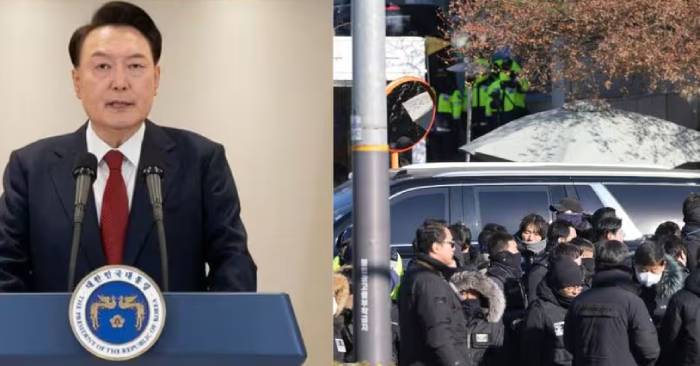
Seoul: Impeached South Korean President Yoon Suk Yeol was detained on Wednesday following the controversial imposition of martial law in December, escalating the ongoing political turmoil in the nation. The arrest took place after a tense standoff at his residence in Seoul, marking a dramatic turn in the high-profile case.
In a video message released before his detention, Yoon criticized the legal process, claiming that “the rule of law has completely collapsed in this country.” Despite his critique, he stated his intention to comply with the detention warrant to avoid clashes between law enforcement and his security team.


Yoon, who had been confined to his residence for weeks, was escorted under heavy police guard to the Corruption Investigation Office for High-Ranking Officials in Gwacheon. This was the second attempt to detain him after security forces initially resisted, deploying barriers, buses, and barbed wire.
The former president justified his December 3 martial law declaration as a necessary measure to counter legislative opposition to his governance. However, the anti-corruption agency is investigating whether his actions constituted an attempted rebellion. The Seoul Western District Court upheld his detention warrant, which remains valid until January 21, despite objections from his legal team.
Protests erupted near Yoon’s residence, with supporters and opponents demanding contrasting actions. Thousands of police officers were deployed to manage the escalating tensions.
Yoon’s impeachment, initiated by the opposition-controlled assembly on December 14, suspended his presidential powers. The Constitutional Court has begun deliberations on whether to permanently remove him from office, with the next hearing set for Thursday.
This detention underscores a deepening crisis in South Korea’s governance, drawing attention to its legal processes and political stability.