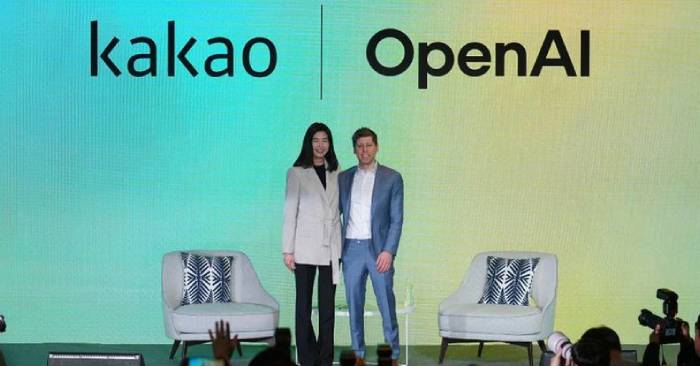
In a bold move to secure its global competitive edge, OpenAI chief Sam Altman has cemented a strategic partnership with South Korea’s tech powerhouse Kakao. Announced in Seoul on Tuesday, this agreement will allow Kakao to integrate ChatGPT into its suite of innovative AI services, which power popular platforms including an online bank, South Korea’s largest taxi-hailing app, and the widely used messaging service KakaoTalk. This collaboration forms part of a broader global alliance led by OpenAI at a time when the industry is being shaken by the emergence of Chinese competitor DeepSeek—a newcomer whose high performance and low cost have sparked intense debate in Silicon Valley.
Altman’s initiative comes as his company also participates in the ambitious Stargate drive, a project announced by US President Donald Trump that aims to invest up to $500 billion in AI infrastructure across the United States. This push for investment underscores the urgency felt within the sector amid rapid technological shifts and competitive pressures. DeepSeek’s breakthrough performance has led some to accuse it of reverse-engineering the capabilities of established US AI models like ChatGPT, triggering concerns over intellectual property practices and prompting OpenAI to heighten its cooperation with US authorities.


Beyond the Kakao deal, Altman’s agenda in South Korea included meetings with major chip manufacturers. In Seoul, he engaged with SK Group chairman Chey Tae-won and SK hynix CEO Kwak Noh-jung to discuss potential collaborations on advanced AI memory chips—including high bandwidth memory—and to explore further enhancements to AI-driven services. A forthcoming meeting with Samsung Electronics chairman Lee Jae-yong is also on Altman’s schedule, highlighting OpenAI’s commitment to forging robust partnerships across the semiconductor landscape. These strategic alliances are seen as critical to sustaining innovation and ensuring that OpenAI remains at the forefront of the rapidly evolving global AI arena, even as competitors push the boundaries of existing technology through methods such as model distillation.