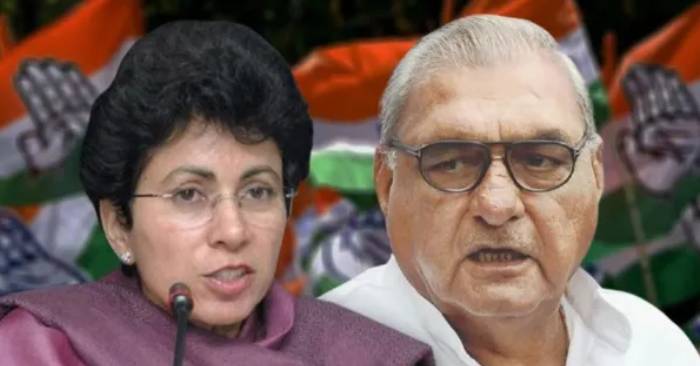
As the Haryana Assembly elections approach, Congress has controversially sidelined Kumari Selja, one of its most prominent Dalit leaders. Known for her grassroots appeal, Selja has been pushed to the margins to ensure that former Chief Minister Bhupendra Singh Hooda’s influence remains intact. This move signals a deeper issue within the party, raising concerns about anti-Dalit bias. Although Selja was increasingly active in the lead-up to the elections, her role was abruptly reduced, pointing to deliberate efforts to sideline her.
Despite Rahul Gandhi’s efforts to highlight caste-related issues and champion the cause of oppressed communities, the Congress party has failed to support Selja, a powerful Dalit woman leader. The leadership has seemingly chosen not to challenge Hooda’s stronghold, allowing his influence to dominate.


Hooda’s sway over Haryana Congress is unmistakable, reflecting a broader strategy to minimise Selja’s political presence. She had previously raised concerns about the biased ticket distribution process during the Lok Sabha elections, where she noted that Hooda’s camp favoured outsiders. This imbalance is evident again in the Assembly elections, with 72 out of 89 Congress candidates aligned with Hooda, while only nine are associated with Selja.
Despite Selja’s efforts to back candidates like Vidya Rani Danoda and Himmat Singh, they were denied tickets, further highlighting her diminished role. After the Lok Sabha elections, Selja had ambitions to run for Chief Minister but was blocked by party leadership. Her exclusion underscores a broader trend within Congress of sidelining Dalit leaders.