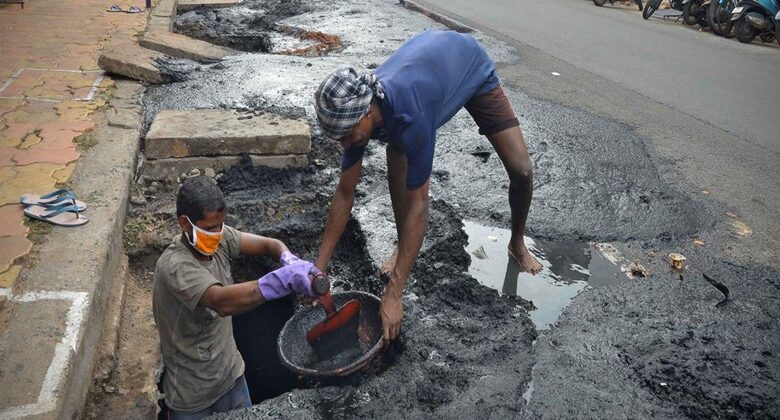
The DMK-led government in Tamil Nadu is under fire for not following its promise to end manual scavenging, a practice it had vowed to abolish in the name of social justice. Despite repeated assurances of safety and dignity for sanitation workers, the state continues to witness deaths in sewage pits and septic tanks, exposing a deep gap between promises and action.
Before the 2021 Assembly elections, DMK leaders pledged to eliminate manual scavenging. Their manifesto spoke of modernisation, mechanised cleaning systems, and strict laws against deploying humans for hazardous sanitation work. These promises, seen as part of the Dravidian movement’s commitment to social equality, gave hope to thousands of sanitation workers across the state.


But the reality, four years later, words didn’t come into action. Sanitation workers continue to die while cleaning drains and septic tanks, often without proper safety gear or supervision. Each death tells a story of negligence, silence, and indifference. Families of victims say officials make promises of compensation but fail to deliver justice or lasting solutions.
As per the record of Manual Scavenging Deaths:
- 2021: Between 6 and 10 workers died.
- 2022: The toll rose to 14-16.
- 2023: At least 15 to 18 deaths were reported, with five occurring in May alone.
- 2024: Another 12 to 15 workers lost their lives.
- By September 2025, 8 deaths had already been recorded, including three in a single incident in Tiruppur.
Another tragedy struck recently at Thiruppathi Nagar near Balaji Nagar in Kolathur, Chennai, where a sanitation worker named Kuppan suffocated to death after inhaling toxic gases while cleaning a sewage canal. He died instantly. Activists say incidents like this are far more common than reported, claiming the actual numbers are much higher.
Critics argue that the government’s efforts remain largely cosmetic. While robotic cleaning machines were introduced in select areas like Chepauk in 2021, the wider rollout has been painfully slow. In most districts, workers still rely on rudimentary tools and manual labour to clean septic tanks.
The Annal Ambedkar Business Champions Scheme (AABCS), designed to help sanitation workers become entrepreneurs, has also failed to make a meaningful impact. Activists say that by mid-2023, the scheme remained largely on paper, with few beneficiaries and little transparency. Political allies such as the Viduthalai Chiruthaigal Katchi (VCK) and the Congress, known for their strong stance on social justice, have stayed mostly silent on these deaths.
For many among marginalised communities, this silence feels like a betrayal of their long struggle for dignity and equality. Almost all victims of manual scavenging come from marginalised castes. Yet, convictions in such cases are rare. Families of the deceased often wait months – sometimes years – for compensation. Many say they are treated as statistics, not citizens deserving of justice.
The DMK’s 2021 manifesto promised to replace human labour with machines, rehabilitate workers, and enforce accountability. Four years on, Tamil Nadu’s sewage pits still claim lives. Critics say the state’s focus has shifted from reform to optics – from change on the ground to claims on paper. Until the government enforces real accountability, accelerates mechanisation, and treats sanitation workers with the dignity they deserve, the promise of ending manual scavenging will remain unfulfilled, a haunting reminder of lives lost and promises broken.