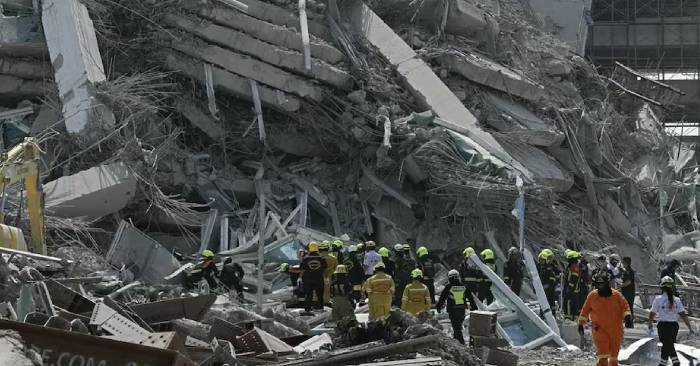
A catastrophic earthquake struck Myanmar and Thailand on Friday, claiming nearly 150 lives and leaving hundreds injured. The 7.7-magnitude quake hit northwest of Sagaing in central Myanmar in the early afternoon, followed by a 6.4-magnitude aftershock minutes later. The disaster caused widespread destruction, leveling buildings, damaging roads and bridges, and even collapsing a 30-storey high-rise under construction in Bangkok, Thailand.
Humanitarian Crisis and Myanmar’s Plea for Help
The full extent of the destruction is still unfolding, but Myanmar’s ruling military leader, Min Aung Hlaing, confirmed that 144 people had died, with over 732 others suffering injuries. Three fatalities have also been reported in Thailand. Acknowledging the massive humanitarian crisis, he issued a rare international appeal, urging countries and organizations to provide assistance. “I welcome help from any country, organization, or individual willing to support our people,” he stated in a televised address.


Myanmar’s already fragile healthcare system, strained by ongoing civil conflict, is struggling to cope with the disaster. A state of emergency has been declared across the six most affected regions. The World Health Organization (WHO) has warned that the earthquake poses a significant threat to life and public health.
Hospitals Overwhelmed as Search and Rescue Efforts Continue
Hospitals in Naypyidaw are overwhelmed with casualties. A major hospital’s emergency department entrance collapsed onto a car, turning the facility into what one doctor described as a “mass casualty area.” Medical professionals, stretched to their limits, are treating the injured in open spaces outside the hospital.
Rescue operations are ongoing, with emergency teams working through the night to extract survivors from the rubble. Journalists witnessed efforts to save a mother and her son trapped in a collapsed building in Naypyidaw. Despite severe injuries, responders struggled to reach them amid the debris.
Widespread Destruction in Thailand
The tremors also caused severe damage in neighboring Thailand. In Bangkok, a massive under-construction skyscraper crumbled within seconds, burying workers under heaps of debris. Officials confirmed three deaths, while dozens remain unaccounted for. Distressed bystanders reported hearing cries for help from those trapped beneath the ruins.
Rescue workers, illuminated by floodlights, continued their operations late into the night. Thai Prime Minister Paetongtarn Shinawatra visited the site and announced that all buildings in Bangkok would require safety inspections. Authorities declared an emergency zone in the city, temporarily suspending metro and light rail services. Panic spread across the capital as people evacuated buildings, some seeking refuge in public parks.
Global Response and Historical Context
The earthquake was felt across multiple countries, including India, China, Bangladesh, and Cambodia. Governments and international organizations quickly responded, with India, France, and the European Union pledging aid. The WHO mobilized its logistics hub in Dubai to prepare trauma supplies. Pope Francis also expressed sorrow over the devastation.
Myanmar has a history of strong earthquakes, particularly along the Sagaing Fault, which runs through the country. Between 1930 and 1956, at least six quakes of 7.0 magnitude or higher struck the region. In 2016, a 6.8-magnitude earthquake in Bagan damaged historic temples and claimed three lives.
As Myanmar and Thailand grapple with the aftermath of this latest disaster, rescue efforts continue, and the world unites to provide relief to the affected communities.